
transparent

Search:

Loading

Institution of

Collaborating Centre for Zoonoses in Europa

Press Releases

New Releases for Download

News

Photo: Icosahedron on the meadow : The winning design proposal for the external works of the FLI by the Berlin artist Barbara Trautmann (© Barbara Trautmann)

Jury announces winners of art contest for Friedrich-Loeffler-Institut on the island of Riems

On Tuesday, April 30, the winners of the nationwide “art for architecture” contest for the Friedrich-Loeffler-Institut were selected. The contest had been set up by the Federal Republic of Germany, represented by the Betrieb für Bau und Liegenschaften Mecklenburg-Vorpommern (BBL M-V), as part of the comprehensive building project of the FLI on the island of Riems. A supra-regional jury chaired by Leonie Baumann, chancellor of the Berlin-Weißensee Art College, recommended the large surface sculpture „Insulaner“ (islanders) designed by Barbara Trautmann for the external works of the institute and the mural „Grenzen und Ereignisse” (borders and events) designed by Matthias Geitel for the interior of the conference facilities. As of July 3, the Pommersche Landesmuseum Greifswald will exhibit all design proposals submitted in the frame of this contest.

more 

Human infections with avian influenza virus H7N9 in China

18 April 2013

The FLI provides up to date information on Human infections with avian influenza virus H7N9 in China.

more

Foto: Moschusentengruppe (© FLI)

Human infections with avian influenza virus H7N9 in China

8 April 2013

In early April 2013, first cases of disease – some of them fatal – were reported in China in humans infected with an avian influenza virus (AIV) of the subtype H7N9. Apparently, several persons with confirmed infection showed severe flu-like symptoms and later on developed a critical condition, some of them died. Currently, these sporadic cases are concentrated in Shanghai and three neighboring regions. So far, there is no evidence of a human-to-human transmission. It is likely that the affected persons acquired the infection by direct contact with birds/poultry.

more

FLI provides cover story

in the March issue of The Journal of Immunology

With their article on anti-bacterial defense mechanisms in infected immune cells, scientists of the Institute of Immunology and the Institute of Molecular Pathogenesis of the Friedrich-Loeffler-Institut provide the cover story of the current issue of The Journal of Immunology.

Chlamydiae are intracellular pathogens that infect cells and cause serious diseases in humans and animals. Dendritic cells are among the first immune cells encountered by Chlamydia during infection. They are equipped with specialized machinery that promotes effective display of MHC I and II/peptide complexes, rendering them the most potent stimulators of T cells. The work of the group of Dr. Michael Knittler of the Institute of Immunology is focused on studies investigating uptake and processing of chlamydial antigens by immune cells. The recently published work identifies autophagy as key mechanism of dendritic cells in MHC I-presentation of chlamydial antigens. These findings provide new insights into the mechanisms of cellular immune defense against intracellular bacteria and have important implications for the future design of therapeutic strategies.

about the cover image
to the article
to the workgroup of PD Dr. Michael Knittler
to the workgroup of Prof. Dr. Elisabeth M. Liebler-Tenorio

Information on pests of honey bees

The National Reference Laboratory for Bee Diseases provides information on pests of honey bees. The fact sheets on Tropilaelaps mites and the Small hive beetle have been generated in cooperation with the European Union Reference Laboratory for honeybee health and the Food and Environment Research Agency.

Go to NRL for Bee Diseases

Abb.: Zoonoses and Public Health: Cover image for Vol. 60 issue 2

Study on the costs of BSE control measures 2000-2010 now published

A recently published study conducted by the FLI estimates the costs of BSE control measures. The study revealed that the most important cost factors were the feed ban on animal proteins for farmed livestock and the resulting disposal of the materials.

more  

Photo: Cow, FLI Riems

Update on Schmallenberg virus

January 31, 2013

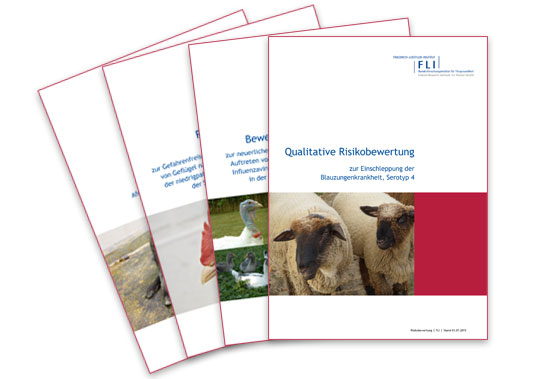
The FLI Factsheet on Schmallenberg virus provides an update on the causative agent as well as the transmission an epidemiology.

to article

Foto: Rinder im Stall

Vaccinated or infected?

Marker vaccines in the fight against animal diseases

Vaccination is an essential tool in modern health care and animal disease control. However, if used in certain animal diseases, vaccines may even be an obstacle to an effective disease control, as antibody tests are unable to differentiate between conventionally vaccinated and infected animals. In the latest issue of the ‘Forschungsreport’, FLI scientists report how vaccination with a marker vaccine can enable differentiation between antibodies generated by vaccination and those produced by infection and for which diseases these novel vaccines are already in use or at advanced stages of development.

to article (in german language only)

Photo: Cow, FLI Riems

Detection of Schmallenberg virus RNA in semen samples

Riems, 21 Dec 2012

The Friedrich-Loeffler-Institut (FLI) detected Schmallenberg virus (SBV)-genome in the semen of bulls with a known SBV-antibody status. All samples were investigated with an optimized RNA extraction method and a real-time RT-PCR (RT-qPCR) system developed and established at the FLI. If SBV can be transmitted by SBV-positive semen is still under investigation.

more  

Photo: Orthomyxovirus (electron micrograph: Harald Granzow, FLI)

Synthetic mRNA-vaccine protects from influenza

In cooperation with their colleagues from Curevac GmbH, Tübingen, scientists of the Friedrich-Loeffler-Institut (FLI) were able to demonstrate for the first time that a synthetic mRNA vaccine protects against infectious disease. Mice, ferrets and pigs immunized with the vaccine developed a specific antibody-mediated as well as cellular immune response, which protected them from infection with influenza viruses like the causative agents of bird or swine flu. According to the publication of the work group around Prof. Lothar Stitz, head of the FLI's Institute of Immunology, in the scientific journal "Nature Biotechnology", the vaccine is fully synthetic, which makes its production time considerably shorter than that of conventional vaccines.

to details 

Older news can be found in the archive:

to archive